How to Verify a Clothing Manufacturer Before Paying a Deposit
A practical checklist for confirming a factory is real, capable and solvent — before your deposit leaves your account.
Every year, buyers lose money to the same handful of failures: a trading company posing as a factory, a factory that subcontracts to a workshop you never saw, or — increasingly — a legitimate factory whose email is compromised and whose bank details are swapped mid-order.
None of those failures are exotic. All of them are preventable with about two hours of checking before the first payment.
Step 1 — Confirm the legal entity exists
In China, every registered business has a 18-digit Unified Social Credit Code. Ask for it and check it in the National Enterprise Credit Information Publicity System (gsxt.gov.cn). What you are looking for:
- Registered capital — under RMB 1 million is a small operation. Not disqualifying, but it tells you the scale.
- Establishment date — a company registered eight months ago is not a ten-year factory, whatever the website says.
- Business scope — does it include garment manufacturing, or only trading and import/export?
- Abnormal operations list — any entry here is a serious flag.
Also ask for the business licence scan and compare the company name to the name on the Proforma Invoice and the bank account. All three must match exactly. A mismatch is the single most common precursor to a loss.
Step 2 — Establish whether they actually make the product
Roughly half of the companies presenting themselves as factories are trading companies. That is not automatically bad — a good trading company adds coordination value — but it changes your risk profile and your price.
Four questions separate the two quickly:
- "How many sewing lines do you run, and how many machines per line?" A real knitwear factory answers with specifics (for example, four lines, 22 machines each).
- "Which processes are in-house and which are outsourced?" Knitting, dyeing, cutting, sewing, and finishing are rarely all in-house. The honest answer names the outsourced ones.
- "Can I see a short video of the line running my fabric?" Ask for something specific — the cutting table with your approved sample on it — rather than a generic factory tour montage.
- "What is your monthly capacity in pieces?" A factory producing 30,000 pieces a month cannot absorb a 100,000-piece order in six weeks, no matter what the salesperson promises.
Step 3 — Video audit, or a third-party inspection
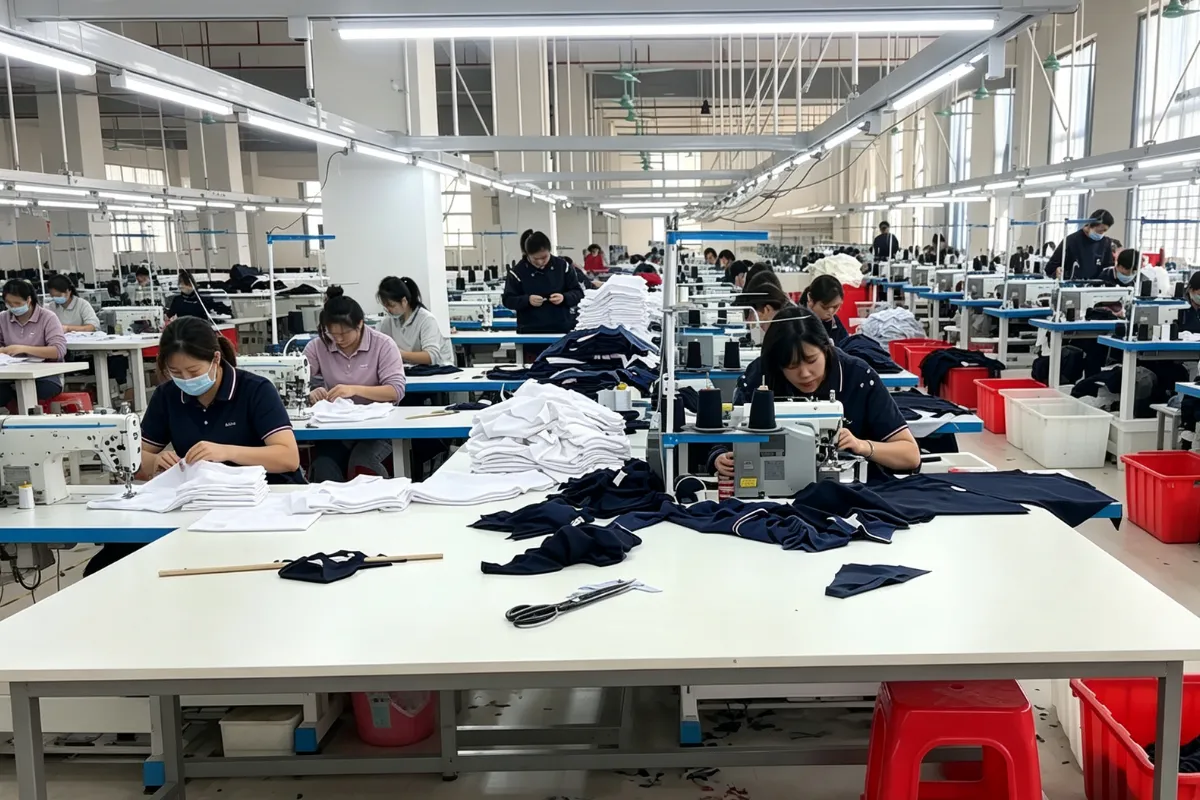
If you cannot visit, a live video call is worth more than any PDF. Ask for a walkthrough in a single continuous call with no editing, covering: fabric storage, cutting, sewing lines, pressing, packing, and the finished goods area. Ask them to open a carton of a current order.
For orders above roughly USD 20,000, a third-party factory audit (SGS, Intertek, QIMA, Bureau Veritas) costs USD 300–800 and produces a report covering capacity, machinery, worker count, and existing certifications. If a factory resists an audit, that is your answer.
Certifications worth asking for, and what they actually mean:
| Certificate | What it covers | Note |
|---|---|---|
| ISO 9001 | Quality management system | Process documentation, not product quality |
| BSCI / Sedex | Social compliance, labour conditions | Often required by EU and US retail buyers |
| OEKO-TEX Standard 100 | Harmful substances in finished fabric | Ask for the certificate number and check it |
| GRS | Recycled content | Must be traceable through the supply chain |
| WRAP | Production facility compliance | Common for US-bound orders |
A certificate with no number, or a number that does not verify on the issuing body's website, is a decoration.
Step 4 — Test them with a sample before a bulk order
A sample order is a low-cost behavioural test. What to watch:
- Response time — how fast do they answer questions during sampling, not just before?
- Honesty about problems — do they tell you when a fabric is unavailable, or silently substitute?
- Specification discipline — does the sample match the measurements you asked for, within tolerance?
- Photo documentation — do they send measurement photos without being asked twice?
A factory that is sloppy on a USD 50 sample will be sloppy on a USD 50,000 order.
Step 5 — Protect the payment itself
This is where most losses actually happen.
- Pay to the company account, never a personal account. A request to send money to an individual's account is a red flag with no legitimate explanation in normal trade.
- Verify bank details by a second channel. Before sending a deposit, confirm the account number by phone or video call with a person you have already spoken to. Email-only confirmation is exactly how the mid-order bank-detail swap works.
- Use a written contract or a detailed PI. It should state the product spec, quantity, price, Incoterm, delivery date, inspection rights, and the remedy for late delivery or defects.
- Structure payments against milestones. 30% deposit, 70% against the pre-shipment inspection report is standard and reasonable. 100% up front is not.
- Consider a letter of credit for large orders. Above roughly USD 50,000, an L/C costs 1–2% and removes most counterparty risk.
Step 6 — Know the warning signs
Walk away — or slow down sharply — if you see:
- Pressure to pay quickly because "the price is only valid today"
- A bank account in a different company name than the PI
- Refusal to provide a business licence or credit code
- Certificates with no verifiable numbers
- A factory address that does not appear on any map, or resolves to an office building
- Sudden changes in the contact person's email domain mid-order
- No willingness to sign anything beyond a one-page invoice
The two-hour version
If you only do four things:
- Check the credit code on gsxt.gov.cn.
- Confirm the bank account name matches the business licence exactly, by phone.
- Get a live, unedited video walkthrough of the production floor.
- Order one sample and judge how they handle a problem.
That covers the failures that account for most of the money lost in this industry. Everything else is refinement.
We encourage every new buyer to audit us before the first deposit — licence, credit code, live video call, or a third-party visit. The paperwork is faster to produce than a dispute is to resolve. Our own company background and quality process are documented for exactly this purpose.
Planning an order this season?
Send your style, quantity and target price — we reply within one business day with fabric options and a quotation.