Fabric Guide: Cotton vs Nylon-Spandex for Hot Climate Markets
What actually performs in 35°C and 80% humidity — and how to choose a knit fabric for the Gulf, Southeast Asia, South America and northern Australia.
A polo that sells in Manchester and a polo that sells in Dubai are not the same garment, even when they look identical in a photo. Heat and humidity change what a fabric does on a body: how fast it dries, how it clings, how it smells at the end of a working day, and how it survives a wash cycle that happens twice as often.
Buyers who ignore this ship a product that photographs well and returns badly. Here is what actually matters.
The four fabrics that dominate hot-climate knitwear
| Fabric | Weight | Dries | Hand-feel | Cost index | Best for |
|---|---|---|---|---|---|
| 100% cotton pique | 160–220 gsm | Slow (60–90 min) | Dry, structured | 1.0 | Retail basics, corporate |
| Cotton / modal blend | 160–200 gsm | Medium | Soft, drapey | 1.25 | Premium casual |
| Nylon-spandex (with mesh) | 140–190 gsm | Fast (20–30 min) | Cool, smooth, stretch | 1.5–1.9 | Golf, active, travel |
| Polyester micro-mesh | 130–170 gsm | Fastest | Slightly synthetic | 0.75 | Promo, teamwear, price-led |
Why 100% cotton struggles above 32°C
Cotton is comfortable because it absorbs moisture. In dry heat that is an advantage — sweat evaporates from the fibre and cools the skin.
In humidity above 70%, that same property works against you. The fibre holds water and stops releasing it, so the garment stays damp against the body for a long time. Add a fitted cut and you get cling, visible sweat marks, and a shirt that feels heavy by mid-afternoon.
This does not make cotton wrong for hot markets. It makes weight and cut critical:
- Go lighter, not heavier. 180 gsm is the ceiling for Gulf and Southeast Asian retail; 220 gsm is a European preference.
- Loosen the fit. A relaxed body with a straight hem moves air; a slim fit traps it.
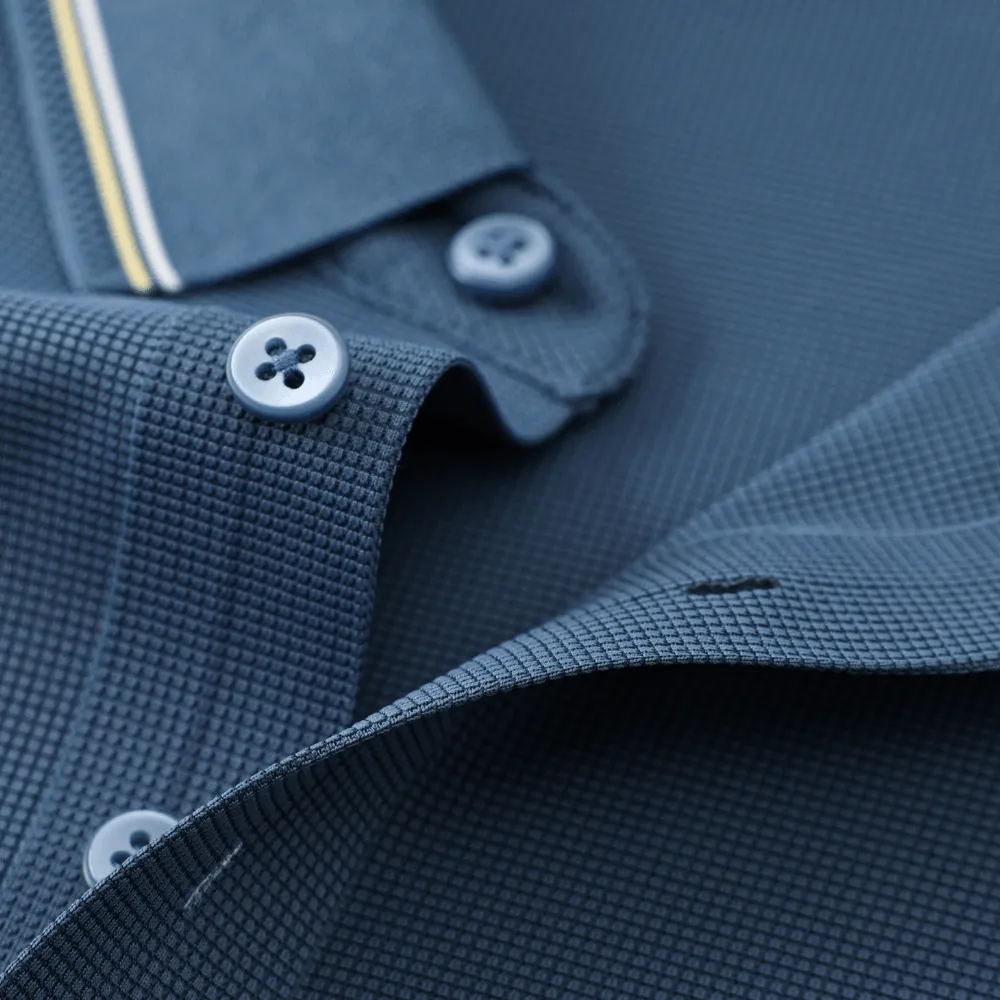
- Choose an open structure. Pique and mesh knit breathe far better than a dense interlock at the same weight.
Why nylon-spandex wins in humidity
Nylon-spandex knits — usually 78–86% nylon with 14–22% spandex — behave differently:
- They wick rather than absorb. Moisture moves to the surface and evaporates, so the fabric dries in 20–30 minutes instead of 90.
- They stretch and recover. 15–20% four-way stretch means the garment moves with the body instead of pulling across the shoulders.
- They hold shape after washing. No collar roll, no hem flare.
- They feel cool to the touch at the start of wear, which is a real sensory selling point in 40°C.
The trade-offs are honest ones: nylon-spandex costs 50–90% more per garment than cotton pique, it needs a mesh structure to avoid feeling clammy, and it reads as "performance" rather than "classic menswear". In markets where a polo is worn to the office, that last point matters.
The middle path most buyers end up on
For the Gulf, Southeast Asia, northern Australia and coastal South America, the fabric that satisfies both retail positioning and climate performance is usually a cotton-modal or cotton-nylon blend in the 170–190 gsm range, with a mesh or pique structure:
- 60% cotton / 40% modal — soft, breathable, drapes well, moderate drying time
- 65% cotton / 30% nylon / 5% spandex — better recovery, faster drying, still reads as cotton
Both keep the classic look while removing the worst humidity failure modes. Cost sits roughly 25–40% above straight cotton pique — usually absorbable at a retail price above USD 35.
Colour and heat
Two colour decisions matter more than buyers expect in hot climates:
Light colours reflect, dark colours absorb. In direct sun, a black polo can run 8–12°C hotter at the surface than a white one. This is why white, sand, stone and pale blue dominate Gulf retail. Deep colours still sell, but they belong in evening and indoor ranges.
Dark shades show salt. After a day of sweating, black and navy show white salt lines on the back and under the arms. If you are selling dark colours into a humid market, a fabric with a wicking finish — or a slightly mottled/heather surface — hides it far better.
Sun protection
For Australia and the Gulf, UPF is a selling point worth printing on the hangtag. Typical values:
- Standard cotton pique: UPF 15–25
- Dense knit, dark colour: UPF 30–40
- Nylon-spandex with tight construction: UPF 40–50+
If you claim UPF 50+, it needs to be tested (AATCC 183 or AS/NZS 4399) and the test report should exist. Unsupported UPF claims are a compliance risk in Australia specifically.
Washing behaviour
Hot-climate customers wash more often — often daily in summer. That changes what "durable" means:
- Shrinkage must be under 3% after three washes. Ask for the tested figure, not a promise.
- Colour fastness to washing should be grade 4 or better; to light, grade 4 for outdoor ranges.
- Pilling (Martindale or ICI) matters most on cotton-modal, which is softer and therefore more prone to surface fuzz.
- Elastane degradation is the hidden failure of nylon-spandex: chlorine and hot wash break down spandex over time. A heat-set, chlorine-resistant spandex costs a little more and lasts twice as long.
A practical recommendation by market
| Market | Recommended default | Upgrade path |
|---|---|---|
| Gulf (UAE, KSA, Qatar) | 175–185 gsm cotton pique, light palette, relaxed fit | Cotton-nylon with wicking finish |
| Southeast Asia | 170–180 gsm cotton-modal, breathable pique | Nylon-spandex mesh for golf/active |
| Northern Australia | 180 gsm cotton pique with UPF claim | Nylon-spandex, UPF 50+ tested |
| Coastal South America | 180–200 gsm cotton pique | Cotton-modal for premium tier |
We knit all four of these fabrics and can send a swatch card with weights, compositions and tested shrinkage for each. Tell us the destination market and retail price, and we will narrow it to two options instead of ten. Swatches ship with our sample packs.
Planning an order this season?
Send your style, quantity and target price — we reply within one business day with fabric options and a quotation.